Spring is eventually on the horizon – and I couldn’t be happier. With fragile flowers setting up to bloom and the sunlight environment later on in the working day, we’re commencing to see the changeover from winter season to spring, and the excitement of a new …
The most indulgent, luxurious, and expensive-looking homes are all about comfort and character, therefore, the materials you choose will be of utmost importance if you want a home that exudes luxury. But before you invest in a complete revamp, think critically, because spending a …
By now you’ve probable browse the testimonials of the new generative AI chatbot embedded in Microsoft’s Bing lookup engine: how in an trade with New York Occasions reporter Kevin Roose it turned into a lovelorn stalker, professing its enjoy for him and hoping to get him to depart his spouse, or when it instructed an Affiliated Press reporter he was ugly and experienced negative tooth, likening him to Adolf Hitler “because you are a person of the most evil and worst individuals in background.”
In individuals evaluations and many others I have read, the target has been on particular somewhat than small business interactions with the chatbot. But Microsoft didn’t spend upwards of $10 billion (and counting) to layout an AI chatbot to discuss with men and women about private matters. The corporation designs to embed generative AI into most of its merchandise and services, ranging from Windows to Business office applications to cloud companies and quite possibly over and above. (At the moment, the Bing chatbot is obtainable only to a limited team of testers by means of the Edge browser the Bing, Edge, and Skype cell apps or the Home windows 11 look for box for those who have the newest Windows 11 update.)
In its original announcement about the new Bing, Microsoft touted the chatbot’s potential to deliver far more total solutions, refine lookup queries, give actionable final results, and give a “creative spark” for information generation. With all that in mind, I decided to see irrespective of whether the Bing chatbot could be valuable as a organization instrument.
To do so, I established an imaginary organization that manufactures and sells office home furnishings. I asked Bing’s chatbot to assist me with a wide range of issues I necessary carried out, like:
investigating how Lean 6 Sigma efficiency approaches may possibly enhance my factory’s performance
finding information about the projected sector dimension for office furnishings in the upcoming 5 a long time and obtaining it develop a chart primarily based on that details
creating textual content I could use for adverts and marketing, as well as creating a deal with for a brochure
My target was to see irrespective of whether the chatbot was a little something far more than a glorified search motor. I required to exam no matter whether it could obtain info, digest it, and then do a little something helpful with what it identified. I looked at the test outcomes as if I were seeking out a new employee.
Some assistance with Lean 6 Sigma
I began by inquiring the chatbot for guidance about how I could use Lean Six Sigma approaches, made use of for streamlining manufacturing processes, to strengthen my manufacturing unit. I informed the chatbot: “I own a small factory wherever I manufacture office household furniture. I might like to use lean 6 sigma approaches to enhance effectiveness and cut expenditures but you should not know wherever to get started. Can you give me tips on how to do it?”
Somewhat than provide an respond to, the chatbot choked. It displayed the concept “Something went incorrect,” with a “Refresh” button following to it. I clicked the button and the chatbot answered, “Of training course, I’m pleased to begin above. What can I support you with now?”
Not stellar start out for a new employee — or a new chatbot. So I simplified my ask for, asking it to convey to me what Lean Six Sigma was. Diverse concern, similar outcome. “Something went erroneous.” I clicked “Refresh.” This time it responded, “Thank you! It is constantly valuable to know when you’re all set to shift on. What can I reply for you now?”
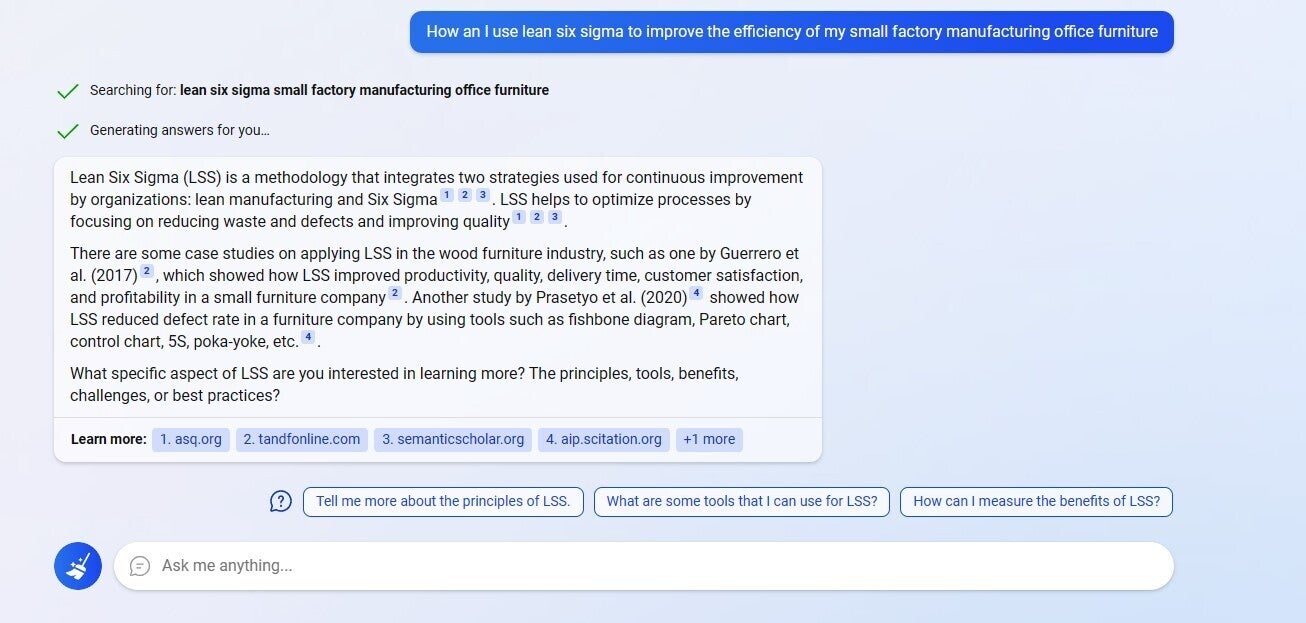
If nothing else, the chatbot was well mannered — despite the fact that at this level, that is all it was. So I tried out once more, providing a very little more detail, inquiring “How can I use lean six sigma to boost the effectiveness of my little manufacturing unit producing business office furnishings?”
Bingo! Last but not least some valuable final results. The chatbot succinctly described Lean 6 Sigma (which it referred to as LSS) and summed up its gains. And it didn’t halt at that — it also identified a scenario review and a report that delved into the benefits Lean Six Sigma provides household furniture suppliers. It furnished footnotes for all this in a “Learn more” box so that I could click to the web pages and comply with up for a lot more specifics.
It also recommended helpful adhere to-up queries I could possibly want answered, these kinds of as “Tell me far more about the concepts of LSS,” “What are some tools that I can use for LSS?” and “How can I measure the benefits of LSS?”
IDG
Soon after quite a few crashes, Bing’s chatbot eventually supplied a practical, in depth answer. (Click picture to enlarge it.)
All in all, an impressive, helpful remedy that could conserve me a sizeable amount of time. I clicked the query about measuring the benefits of LSS. The chatbot crashed. I refreshed it. It responded, well mannered to a fault, and chirpily optimistic: “Got it, I’ve erased the earlier and centered on the existing. What shall we uncover now?”
So I requested it the exact question that I had previously questioned that had yielded the beneficial effects. The chatbot crashed.
I attempted variants of the concern in excess of a period of time of numerous times. At times it crashed. In some cases it offered handy solutions, even though the responses weren’t the very same every time, even if I asked the very same concern in the exact same way. And every single time, when I headed down a path to get much more particulars, it crashed. This steady crashing and inconsistent conduct overshadowed the practical facts the chatbot presented me.
Executing current market analysis and making charts
It was time to move on. I determined to following question it to do sector research and create charts dependent on what it identified. I wrote, “Create a bar chart that reveals the projected current market dimension for business household furniture from 2023 by 2030.”
It crashed. I refreshed and attempted yet again.
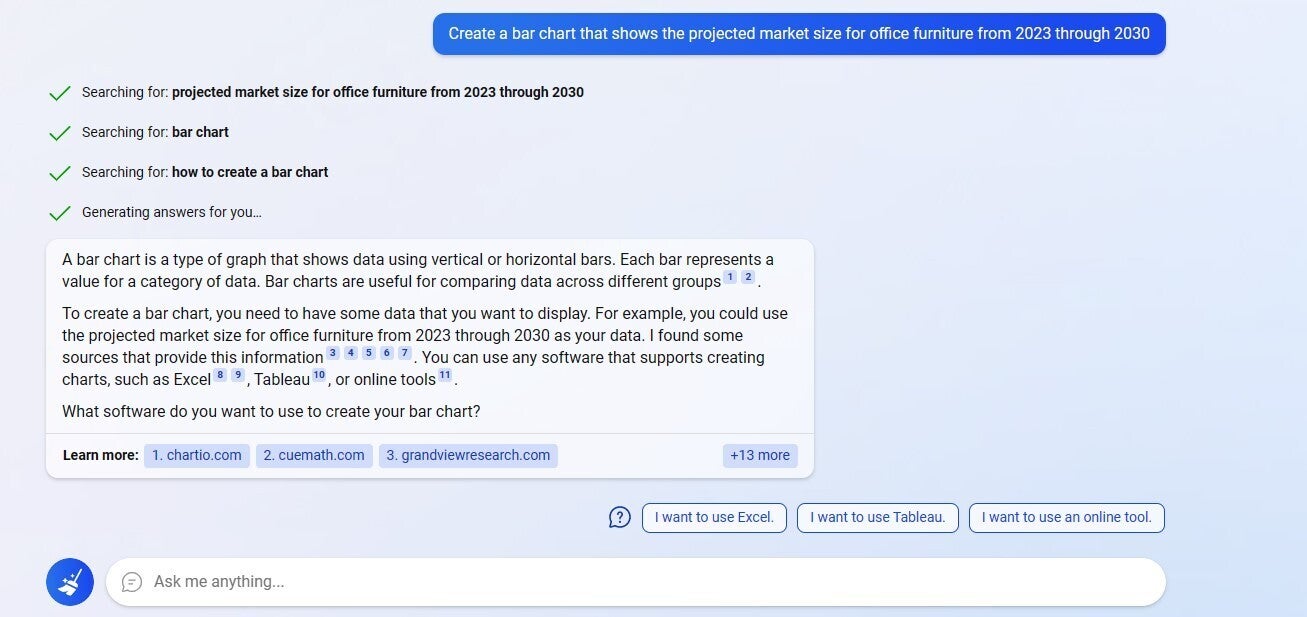
It did not crash this time, but it type of whiffed the dilemma. It informed me what a bar chart is, which I currently realized simply because I requested it to produce a single for me. Then it offered links to resources that it mentioned would offer information about the projected market place sizing for workplace home furnishings in excess of the next 5 years — but it didn’t provide me with the numbers. I’d have to click on through to the internet sites to find it myself. Then it recommended software package, this sort of as Excel or Tableau, that would permit me create the charts by myself.
IDG
At this place, the chatbot can’t establish bar charts. (Click on impression to enlarge it.)
I tried the identical concern once again, and it offered a slightly different remedy. This time it did not squander time telling me what a bar chart is. It once again proposed internet sites I could take a look at to obtain the facts I was seeking for. (The web sites did have the information, by the way.) It advisable added software package to establish the chart, together with RapidTables and Adobe Convey. And it requested me if I preferred advice on how to use these resources, and if so, which one particular I would like to use. I chose Excel, and it gave me a quick tutorial on how to develop a bar chart.
All that was very well and superior, but it did not help you save me time as opposed to applying a common research engine: I could have just as conveniently myself carried out queries for the projected sector sizing and a tutorial on creating bar charts.
I resolved to choose a distinctive tack and attempt a easier request, asking, “What is the projected marketplace sizing for place of work furnishings from 2023 as a result of 2030?” But rather than displaying me marketplace sizing estimates, it showed the projected progress fee. It questioned if I preferred to see progress premiums for a unique location or country — a fantastic, sound adhere to-up. I asked for the numbers for the US, which it promptly furnished. Then it questioned if I wanted info about “market tendencies, drives or segments.” I instructed it to give me projected development for office environment home furniture for residence workplaces.
That was as well significantly for the chatbot to choose. I obtained the “Something went wrong” information and experienced to click “Refresh” to get started a new session.
So for current market study, Bing’s AI isn’t much more than a glorified search engine. It will not do simple multi-component responsibilities like discover info and establish a chart from it. If the chatbot was an worker, at this stage I would have taken it aside and given it a warning that it was not residing up to expectations.
Finding assistance with a internet marketing strategy, promoting duplicate, and a graphic
Upcoming, I questioned for support devising a promoting strategy for a spinoff company — SitAtHome business household furniture for property workplaces. Its now-familiar response: “Something went incorrect.”
I altered tack and requested it to compose internet marketing copy for the company’s goods. I explained the added benefits I’d like emphasised. All it experienced to do was acquire what I experienced published, make it a lot more coherent, circulation greater, and if possible, include a minimal sizzle. Here’s what I requested for:
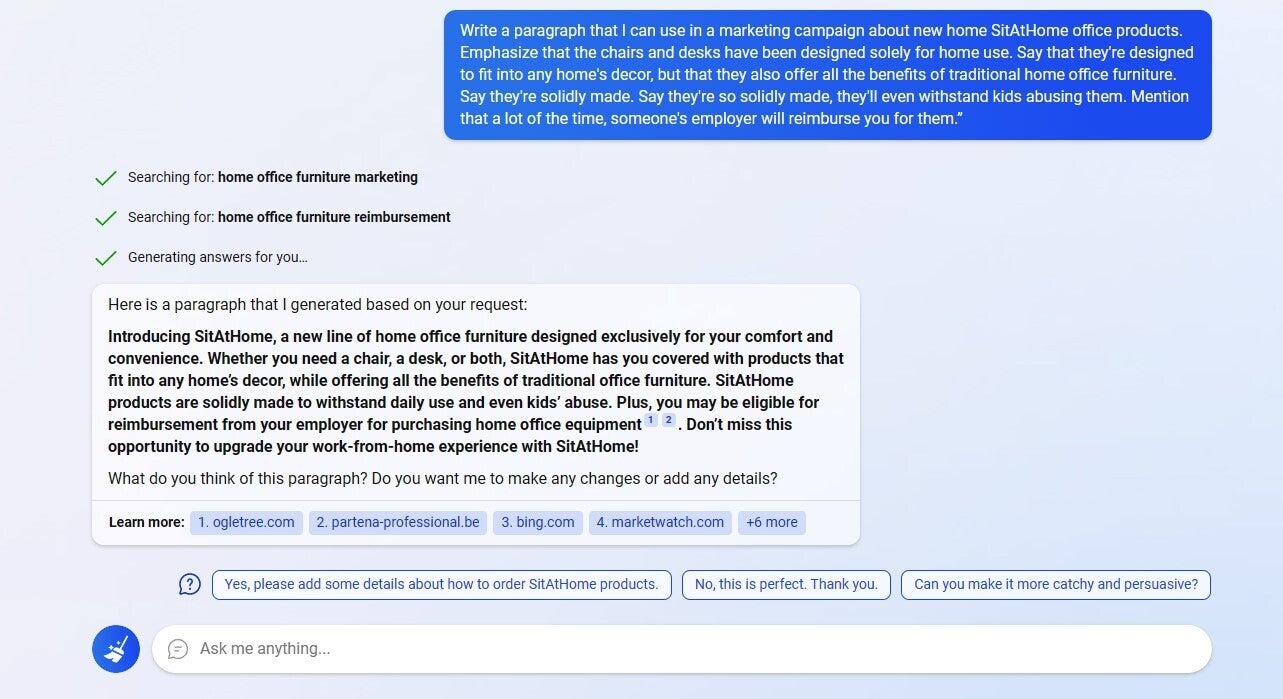
“Write a paragraph that I can use in a internet marketing campaign about new home SitAtHome business merchandise. Emphasize that the chairs and desks have been intended only for household use. Say that they are created to healthy into any home’s decor, but that they also give all the positive aspects of classic property place of work furnishings. Say they’re solidly created. Say they are so solidly manufactured, they will even withstand little ones abusing them. Mention that a large amount of the time, someone’s employer will reimburse you for them.”
The first a few situations I experimented with, the chatbot crashed. But the fourth time was the allure. Here’s what it came again with:
“Introducing SitAtHome, a new line of residence place of work home furnishings created exclusively for your comfort and ease and usefulness. Regardless of whether you need a chair, a desk, or both equally, SitAtHome has you coated with goods that in shape into any home’s decor, while supplying all the added benefits of classic office environment home furnishings. SitAtHome products and solutions are solidly made to face up to day by day use and even kids’ abuse. Plus, you may perhaps be suitable for reimbursement from your employer for buying house place of work products. Never skip this prospect to update your do the job-from-dwelling experience with SitAtHome!”
IDG
Bing chat is correctly capable of creating mediocre advertising duplicate. (Simply click image to enlarge it.)
It was eerily related to almost just about every piece of mediocre advertising duplicate I have at any time study, which includes the ending exclamation point. It requested no matter if I desired to improve the duplicate. I knew improved than to imagine it was capable of accomplishing that. So I told it no, that it was excellent, then thanked it. The chatbot politely replied: “You’re welcome. I’m glad you favored it.”
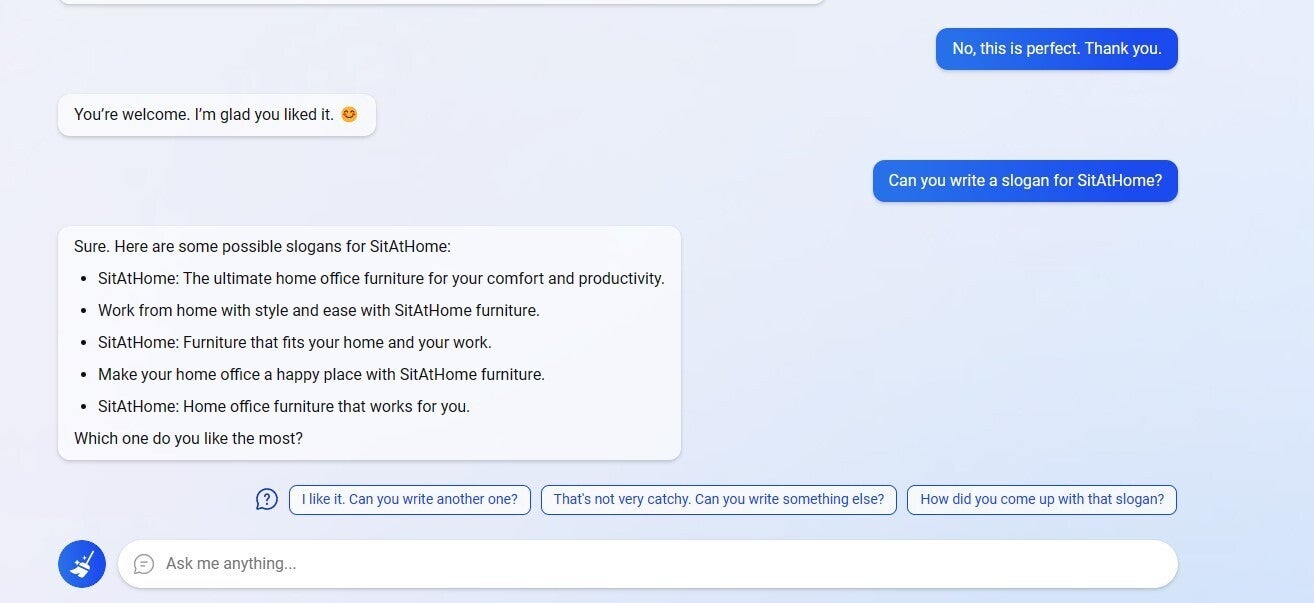
Then I questioned it to write a slogan for the new product line. It complied, gave me five alternatives, and requested which I appreciated most effective.
IDG
The chatbot is an ace at composing mediocre ad slogans. (Click picture to enlarge it.)
They ranged from mediocre to horrible, so I selected the the very least mediocre: “Make your office a content place with SitAtHome home furniture.”
Its response: “I’m glad you favored it. That is my preferred, much too. 😊”
Uh, oh — was the chatbot sucking up to me? To test it out, I responded, “Actually, I favored ‘SitAtHome: Property office environment furnishings that will work for you’ much better.”
The chatbot’s answer: “That’s a superior selection way too. It is very simple and effective. 👍”
Now I realized it was sucking up to me.
It questioned if I needed it to produce a blog site about the rewards of property workplace home furniture. That was an spectacular inquire: it knew I was searching to endorse my new solution line and also realized that a weblog article is a superior way to do that.
It also asked if I wanted it to compose a overview of SitAtHome merchandise. That was also amazing but in an unsavory way. It seemed to know all about marketing’s seamier aspect — corporations composing critiques of their possess products and solutions and hiding the correct authorship when the evaluations are posted on the web.
That was a bridge also much. So I dismissed the requests, and instead asked, “Are you sucking up to me so I’ll give you a promotion?”
And, of training course, the chatbot crashed.
Ultimately, I requested the chatbot to design and style a graphic for the SitAtHome spinoff, of an individual sitting down at a desk in their house workplace. The 1st three times it crashed. On the fourth it supplied generic structure ideas and pointed me to spots I could obtain graphics applications.
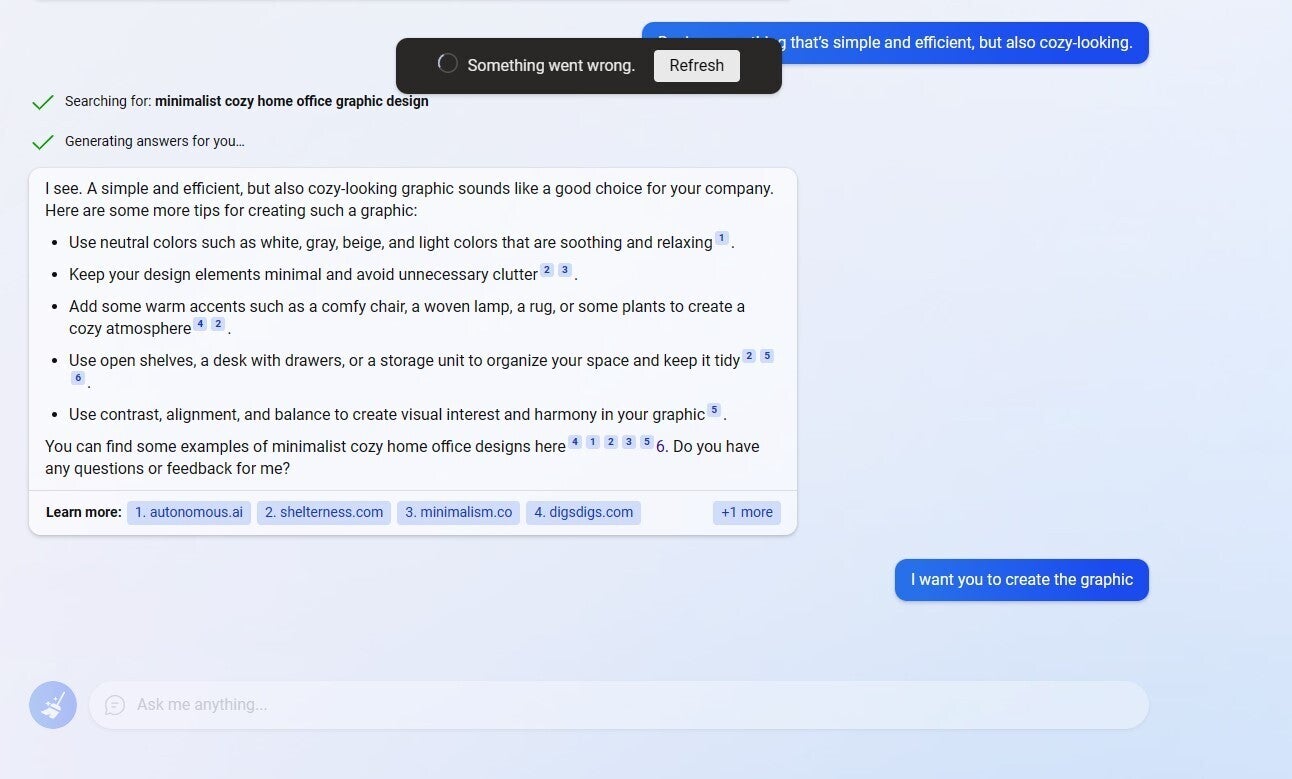
Then it requested whether I want a minimalist, maximalist, or industrial design and style. I experienced no idea what it was chatting about. So I responded, “Design some thing which is straightforward and productive, but also cozy-searching.” It available a few shockingly helpful style suggestions. I then informed it, “I want you to produce the graphic.”
The chatbot crashed.
IDG
The closing straw: one particular as well several crashes. (Click on graphic to enlarge it.)
And that was the final straw. I felt as if I had been working with an staff who continuously refused to conduct the jobs I questioned it to do, who experienced an affinity for performing world wide web searches and nothing at all a lot more, who sucked up to me and proposed I use questionable internet marketing techniques.
On the upside, it was capable of producing mediocre advertising and marketing duplicate and ad slogans. But that wasn’t ample to offset all the bad. If the chatbot ended up an staff, I would have had The Discuss with it and fired it.
The upshot
It’s clear that for now, at minimum, Bing’s AI chatbot is not prepared for the perform planet. It did a strong occupation of accomplishing lookups and summarizing details, and it could also be practical for crafting original drafts of internet marketing duplicate and identical content material — but its penchant for crashing is problematic, to say the the very least.
That reported, I didn’t practical experience the extra damaging concerns that other people have had with the chatbot. I put in a good deal of time with it, not just in studying this report, but interacting with it usually for much more than a week. In that time it by no means gave me incorrect or deceptive info (referred to as an “AI hallucination”), as it did to other testers, and it in no way went about to the dim aspect or displayed creepy habits.
Microsoft is knowledgeable of these challenges — in fact, the business states it unveiled the chatbot to the public as a way to help deal with the issues. Microsoft spokesman Frank Shaw defined to the New York Periods: “We recognize that there is continue to get the job done to be done and are expecting that the technique could make blunders during this preview period of time, which is why the comments is crucial so we can understand and support the versions get better.”
Continue to keep in brain that generative AI is however in its infancy. The Bing chatbot does show authentic promise — able of summarizing information and facts clearly and succinctly and recognizing how to talk to the suitable follow-up issues. Microsoft will probably address the complications resulting in it to crash so often. And as the chatbot carries on to be skilled, its responses will likely turn out to be additional valuable.
Microsoft may at some point enable corporations to coach the chatbot on their individual details sources. In that scenario, it could be remarkably valuable, due to the fact the facts it mines will be exactly the info corporations obtain beneficial.
Beyond that, supplied that Microsoft will be tying AI technological know-how to its Office suite, the chatbot may ultimately be capable to make documents, together with Excel spreadsheets and PowerPoint presentations, primarily based on your requests. At that issue, it could a sizeable efficiency booster.
Regardless of whether all that will take place remains to be seen. Right until then, you may discover it worthwhile to check it out for your function. Just be ready for a lot of disappointment. And get the pink slip completely ready now.
Is your heart established on hardwood flooring for a modern lavatory task? It truly is a trendy option. Even so to assure those boards stay seeking stunning, there are selected caveats to be knowledgeable of. In buy, to make the best assortment for your plan, …
March is recognized as Women’s History Month. It commemorates the vital role of women in American history and encourages studying, observing and celebrating the contributions of women in history and the present day. For much of history, women have faced challenge after challenge, especially when …
From the outside, the David Parr House looks like a typical terraced building in Cambridge, England. Inside, however, the walls of this seemingly unassuming home are adorned with friezes, stained glass, gilded molding and vibrant designs, all crafted by decorative artist David Parr between 1886 and 1927. A representative of the Arts and Crafts movement, which prized handcraftsmanship above mass-produced objects, Parr’s house-turned-heritage siteopened to the public in 2019. Among its visitors was Ella Hawkins, a design historian and author with a unique hobby: creating biscuit art.
Inspired by her trip to the home, which she describes as “without question, the most beautiful house I’ve ever seen,” Hawkins, 29, decided to decorate a batch of biscuits (better known to Americans as cookies) with Parr’s designs. Flavored with orange, cardamon and vanilla, the rectangular treats served as a canvas for her petite paintings of twisting vines, flowers and Gothic script. She shared snapshots of the finished cookies on social media, where they elicited enthusiasm for both her work and Parr’s.
Cookie art inspired by the David Parr House
Courtesy of Ella Hawkins
“He’s this amazing Arts and Crafts working-class guy who went into stately homes and actually painted the walls with incredible designs,” Hawkins says. Artists like Parr have largely been “lost to history, because they’ve not been documented in as much detail as the people who owned the houses.” But now, because Parr applied the same decorative techniques to his own humble abode, he’s starting to gain recognition.
Reflecting on the response to her post, Hawkins adds, “The comments that came in were like, ‘I had never heard of this. Now I will go.’ Or ‘I had no idea this was in Cambridge.’ It’s a way of signposting something, celebrating it, saying, ‘Aren’t these beautiful? Go see them.’”
A scholar of Early Modern English at the University of Birmingham, Hawkins has always loved baking. “I’ve baked for as long as I can remember,” she says. “Everyone knows someone who bakes, and I’m that person.” But she only took this hobby to the next level during Britain’s Covid-19 lockdown, when she decided to send a set of cookies featuring intricate floral designs to her mother. Heartened by her mother’s reaction to the edible artwork, Hawkins started a new project based on textiles by 19th-century designer William Morris.
“I looked around my office and saw a calendar from the Victoria and Albert Museum of the patterns and thought, ‘Why not?’” she recalls. “It was the first time I realized I could create biscuits inspired by anything I wanted.”
Hawkins posted a photograph of the nature-inspired designs on Twitter on February 23, 2021. “If the academia plan doesn’t work out, I’m taking my material culture interests to the cookie industry,” she captioned the image. After going about her day, she returned to her computer to find the post had garnered thousands of likes. (Currently, it boasts just under 200,000 likes.)
In the two years since her viral tweet, Hawkins has developed a sizable social media following. Fans flock to her accounts for her stunning cookie designs, which emulate book covers, scalloped-edged Tiffany lamps, pottery shards, mosaic tiles, medieval manuscripts, Elizabethan fabrics and more. To make this “biscuit art,” Hawkins covers a gingerbread or sugar cookie-like base with royal icing. She uses food coloring gel and vodka (which acts as a thinning agent) to paint patterns onto the cookies, then adds raised elements by piping on royal icing. Most of her designs are rectangular or square, but she’s experimented with other shapes, too, creating an oval portrait of Jane Austen, a black-and-white fox head and randomly broken cookies patterned after Roman pottery fragments.
Ella Hawkins
Photo by Rebecca Knowles
For Hawkins, decorating cookies offers a chance to combine her love of design with her love of history and her love of baking. “I’m a very visual person,” she says. “I think it was something to do with how different visual things like colors, shapes and styles come together to create something as a whole that just clicks with my brain. … I realized I can just look at things and turn them into biscuits, and I just sort of carried on experimenting to see what I could do with that.”
Hawkins’ creations are part of a lengthy tradition of baking and decorating cookies. Known by different names around the world, the sweet little treats run the gamut from filled cookies like Hamantaschen to cut-out cookies like gingerbread to commercially produced brands like Oreos. The word “cookie” was first used in 18th-century Scotland, but variations of the dessert date back hundreds of years.
Sharon Hudgins, an author and editor who’s written about cookies for The Oxford Companion to Sugar and Sweets, among other publications, suggests that “picture cookies” (specially shaped, decorated or stamped treats) now popular in Northern Europe trace their roots to the Julfest, a wintertime celebration held by pre-Christian Germanic tribes. Participants who were unable to spare an animal for the traditional Julfest sacrifice instead fashioned dough into animal shapes.
Lebkuchen on sale at the Nuremberg Christmas Market in Germany
“These dough effigieshave been found in archaeological digs,” Hudgins says. “People ate them just as they would the animal sacrifice. [It] was a continuation of the ritual without having the economic loss of a real farm animal.”
Another modern cookie predecessor originated in Persia, where the Sassanids enjoyed khushkananaj, a baked good made by kneading dough with sesame oil and filling it with sugar and almonds, and kulaija, a similar treat made with a mold, as early as the seventh century. At the time, sugar—a central component of many cookies—was a prized commodity introduced to the region by traders from India. Sugar wouldn’t arrive in Europe until the tenth century, when soldiers returning from the Crusades brought it back to their home countries.
Given sugar’s rarity in the Western world at the time, most early European cookies were unsweetened or flavored with alternative ingredients like honey. It was only during the Middle Ages that these treats were “eaten as a form of pleasure and celebration” rather than for the “largely utilitarian purpose” of alleviating hunger, writes Anastasia Edwards in Biscuits and Cookies: A Global History.
A 16th-century wafer iron depicting the Annunication
Wafers, for instance, evolved from unleavened matzo bread eaten by Jews during Passover. Originally unsweetened, these thin, crisp sheets were stamped with religious imagery and eaten during Christian communion. Medieval clergy used cast-iron tongs imprinted with patterns to hold the dough in place and quickly bake it over a fire. In 1270, a wafer-making guild was established in Paris to help meet the clerical need for wafers; guild members soon branched out, creating secular forms of the cookie that became popular accompaniments to hippocras, a sweet wine served at the end of meals.
It was in Germany, though, that sweet cookies truly came into their own. During the 16th century, spices flowed from Asia to Nuremberg, a crossroad of key European trade routes. Cooks in the German city combined sugar, cinnamon, nutmeg and other spices with locally produced honey to create lebkuchen, spiced honey cakes comparable to gingerbread. Around this same time, wooden, metal and ceramic cookie molds came into wider use, enabling bakers to imprint elaborate designs on anise-flavored springerle and other picture cookies. Initially decorated with religious images, these molds became increasingly secular in the 17th century, with artisans hand-carving depictions of knights, coats of arms, and activities like ice skating and hunting, among other scenes.
“The embossed designs made by molds”—including wafer irons—“were the first forms of actual decorating beyond just shaping a cookie into a form,” says Hudgins.
Springerle made with Christmas-themed cookie molds
As demand for sugar spiked in the 17th century and onward, European nations established sugar plantations in Brazil and the Caribbean, enslaving millions in their quest to produce so-called white gold. By the early 19th century, sugar was widely available and relatively cheap in both Europe and North America.
The growing middle class could now afford to use sugar as a sweetener instead of honey. It was a handy, versatile ingredient and could be used to make glazes that helped keep cakes moist longer. These glazes soon morphed into frosting, a concoction that became especially popular after it was used to decorate Queen Victoria’s 300-pound wedding cake in 1840. In addition to icing, cooks decorated their cakes and cookies with dried or candied fruits, nuts, and colored sugar.
Mass-produced metal cookie cutters similarly gained traction in the mid-19th century. Shaped like people, flowers, animals, hearts or holiday symbols, they presented a playful addition to the dessert menu and were less expensive than handcrafted wooden molds.
The front of a vintage cookie cutter depicting a person on horseback
“With cookie cutters, people could now make a large amount of something, such as heart-shaped cookies, and [they] wouldn’t have to do a lot of decorating because the shape of the cookie is the decoration itself,” says Hudgins.
As sugar became a pantry staple and ovens a fixture in kitchens, home cooks gained the ability to economically turn out a variety of sweets and desserts, including cookies. At the same time, advances in technology gave rise to mass-produced treats, with companies like Huntley & Palmers and Nabisco (which started making animal crackers in 1902) presenting their products as symbols of home and childhood innocence. Writing in Biscuits and Cookies, Edwards notes that the cookie was meant to be seen as “a quiet antithesis to the industrialization of modern life.”
By the 1940s, baking and decorating cut-out cookies had become a popular holiday tradition in the United States. Entrepreneurs like Nettie Williams McBirney, better known as Aunt Chick, crafted Christmas-themed plastic cookie cutters that now sell as vintage collectibles. The American public’s penchant for baking and decorating was further encouraged by the 1963 publication of Betty Crocker’sCooky Book, which featured more than 450 recipes for treats ranging from satin-glazed date drops to chocolate refrigerator cookies.
“In the 1970s and ’80s, making decorated cookies started coming back into fashion,” says Hudgins. “More women had gone into the workforce in the ’60s and ’70s, so in some families there was less cookie baking at Christmas time. Yet there was also an interest by the hippie generation to return to their roots with activities such as home baking.”
More recently, the internet has transformed the world of cookies, offering bakers a place to connect with each other and share recipes and inspiration alike. New technology has also helped cooks put a modern twist on their baked goods.
Small projectors allow artists like Hawkins to cast their designs onto edible canvases. Airbrushing yields dramatic effects, as do brush sets, stencils, piping bags and food coloring markers. And 3D printers allow decorators to create custom cookie cutters and molds.
“Cookie decorating never gets stale,” says Karen Summers, co-founder of CookieCon, the world’s largest gathering of cookie decorators. “There’s always some new technique, some new tool, some new thing [bakers are] implementing. Every time that I think I’ve seen it all, someone will pull out something new, and I think, ‘Whoa! How’d they do that?’”
Hawkins suggests that decorated cookies’ magic stems in part from their ephemerality.
“I think if they weren’t biscuits, if they were paintings or collages, they wouldn’t have the same reaction,” she says. “Part of what they are is temporary. There’s something really weird about it that’s provocative. I’m happy I have photos of them. They’re preserved in that sense. If I had just a drawer full of them, I don’t know what I’d do with them.”
Cookie art inspired by Tiffany lamp designs
Courtesy of Ella Hawkins
Summers agrees.
“There is some level where people want it to last forever, but I think a lot of people just find it a fun challenge to create this masterpiece that is very, very temporary,” she says. “A common theme is to just eat the cookie.”



/https://tf-cmsv2-smithsonianmag-media.s3.amazonaws.com/filer_public/32/44/3244088a-8423-43a8-a381-14d6ef7d3f8e/lede.png "A Brief History of Cookies and Cookie Decorating | History")
/https://tf-cmsv2-smithsonianmag-media.s3.amazonaws.com/accounts/headshot/joan.png)
/https://tf-cmsv2-smithsonianmag-media.s3.amazonaws.com/filer_public/a9/5f/a95f7a30-ef4d-4ea8-bc73-5331cfa80e01/nbd_7.jpg)
/https://tf-cmsv2-smithsonianmag-media.s3.amazonaws.com/filer_public/4b/38/4b3873c3-88a3-4aaf-bcf8-30a243c19e13/ella_hawkins_-_landscape_headshot.jpg)
/https://tf-cmsv2-smithsonianmag-media.s3.amazonaws.com/filer_public/21/f9/21f90895-1976-4a5e-801c-31fe8658f46f/nuernberger_lebkuchen_3183857869_0f3f7bcbe3.jpeg)
/https://tf-cmsv2-smithsonianmag-media.s3.amazonaws.com/filer_public/8b/34/8b344c34-8fef-4ad3-8e8e-0c074b6f7d79/screenshot_2023-02-24_at_22736_pm.png)
/https://tf-cmsv2-smithsonianmag-media.s3.amazonaws.com/filer_public/78/06/7806e16e-cc1e-4b97-b087-498a08de6f9e/1024px-12_days_of_christmas_cookie_mold_and_springerle_6492194515.jpeg)
/https://tf-cmsv2-smithsonianmag-media.s3.amazonaws.com/filer_public/47/55/47555cbe-4a52-463e-8756-2265f5dd3d64/mold.png)
/https://tf-cmsv2-smithsonianmag-media.s3.amazonaws.com/filer_public/08/be/08be96c0-d831-4253-95c2-009fc5f06e89/mek-pfefferkucheform_2tif.jpg)
/https://tf-cmsv2-smithsonianmag-media.s3.amazonaws.com/filer_public/ea/ab/eaab534d-fe3e-46ba-8153-7e3cf8b9fb09/mek-pfefferkucheform_4tif.jpg)
/https://tf-cmsv2-smithsonianmag-media.s3.amazonaws.com/filer_public/b0/8e/b08e37cc-f645-43d3-8a95-cb65b9c66eed/2560px-biscuit_tins_va_2486.jpeg)
/https://tf-cmsv2-smithsonianmag-media.s3.amazonaws.com/filer_public/61/35/61351c86-7eba-48cd-8a05-ea4241bd3e8e/tiffany_glass_biscuits_-_ella_hawkins.jpg)